

Why Companies Ask for a BA Framework
The Efficiency Problem Teams Are Facing
When a company asks you to build a Business Analyst framework, it usually means one thing: something isn’t working. These are the common problems they are trying to solve:
- Projects are likely running into delays
- Requirements are unclear
- Developers are frustrated
- Stakeholders feel like their needs aren’t being fully understood.
In this article I describe all that goes into creating a Business Analyst Center of Excellence which has similar setup to a BA framework.
It’s not always obvious at first, but inefficiency tends to show up in subtle ways—constant rework, repeated meetings, and confusion about priorities. These issues compound over time and eventually become impossible to ignore.
From leadership’s perspective, the Business Analyst function is often seen as the bridge between business and technology. When that bridge is unstable, everything slows down.
According to industry research, poor requirements management is one of the leading causes of project failure contributing to significant cost overruns and missed deadlines.
When leadership asks for a “framework,” what they’re really asking for is structure, clarity, and consistency.
Companies want a way to ensure that work flows smoothly from idea to delivery without unnecessary friction.

What Leadership Actually Wants (But Doesn’t Say)
Here’s the reality—most leaders don’t actually know what a Business Analyst framework should look like.
Leaders want:
- Better outcomes
- Fewer misunderstandings
- Faster delivery
- Predictable results.
The word “framework” sounds strategic, but what they’re really asking for is a system that helps the team work smarter, not harder.
This creates an interesting challenge for you. You’re not just building a set of documents or processes—you’re designing a way of working. And that requires understanding both the business goals and the day-to-day realities of the team. It’s a bit like being asked to design a traffic system for a busy city. You need to know where the congestion is, how people move, and what obstacles they face before you can create something that actually improves flow.
What a Business Analyst Framework Really Is
Framework vs Templates vs Process
One of the biggest misconceptions about a BA framework is that it’s just a collection of templates.
While templates are useful, they’re only a small part of the bigger picture.
A true framework defines how work gets done from start to finish. It includes processes, guidelines, tools, and best practices that help analysts perform their role effectively.
Think of it like a playbook. It doesn’t just tell you what forms to fill out—it guides you on how to approach different situations, how to communicate with stakeholders, and how to ensure that requirements are clear and actionable. Templates support the framework, but they don’t define it.

What Every BA Framework Should Include:
Every business analyst framework should include the following:
- Problem Statement – What problem are we solving with the framework?
- Teams, Roles and Responsibilities – Who does the framework affect? ( Find out about project roles here)
- Tools and Systems – What tools will be used for what? Which is the source of truth? ( see more on tools here)
- Communication Standards – What is the best ways for the steam to stay informed?
- Stakeholder Collaboration – How will we engage with stakeholders?
- Methodology Standards – Will you work in agile or waterfall or hybrid?
- Requirements Documentation Standards – what templates will be used to document requirements? ( Find out about BA documents here)
- Definition of Ready – What criteria need to be met before a requirement is ready for development? ( See examples here)
- Definition of Done – What criteria need to be met before a requirement is considered complete? ( find our more about definition of done here)
- Backlog Management Discipline – How will you manage the backlog?
- Ways of working with Developers and QA – How will you work with the tech team? ( find out more on collaboration here)
- Approvals and Sign Off Cadences – When and how will requirements be approved?
- Change Management – How will changes be managed? ( find out about change of requirements here)
- Testing and Validation – How will you manage UAT and other testing?
- Continuous Improvement – How will the team take feedback and continuously improve? ( You can learn more about retrospectives here)
Why Most BA Frameworks Fail
Many BA frameworks fail because they are too rigid or too complex. Teams are given detailed processes and documentation requirements that are difficult to follow in real-world scenarios. Instead of improving efficiency, these frameworks often slow things down even more. Analysts spend more time filling out documents than actually solving problems.
Another common issue is lack of adoption. If the framework doesn’t align with how the team naturally works, people will ignore it. This is why it’s critical to design something that is both practical and flexible. A good framework should feel like a helpful guide, not a burden.
Step 1: Understand the Current State
Mapping Existing Processes
Before you can build anything new, you need to understand what already exists. This means mapping out the current workflows, identifying how requirements are gathered, documented, and handed off to development. Pay attention to how information flows through the team and where delays or misunderstandings occur.
This step is often overlooked, but it’s one of the most important. Without a clear understanding of the current state, you risk building a framework that doesn’t address the real problems. Take the time to observe, ask questions, and gather insights from different team members.
Identifying Pain Points
Once you have a clear picture of the current process, the next step is to identify pain points. These are the areas where things break down—where communication fails, where requirements are unclear, or where work gets stuck. Common pain points include inconsistent documentation, lack of stakeholder alignment, and unclear priorities.
By identifying these issues, you can focus your efforts on solving the problems that matter most. This ensures that your framework delivers real value rather than just adding more structure.
Step 2: Define What “Good” Looks Like
Setting Clear Objectives
A successful BA framework starts with clear objectives. What are you trying to achieve?
Is it faster delivery, better quality requirements, improved stakeholder satisfaction, or all of the above? Defining these goals will guide your decisions and help you measure success.
Aligning With Business Goals
Your framework should align with the broader goals of the organization. This ensures that your work supports the overall strategy and delivers meaningful results. It also helps you gain buy-in from leadership, as they can see how the framework contributes to business success.

Step 3: Design the Core BA Workflow
Discovery Phase
The discovery phase is where you gather information, understand the problem, and define requirements. This phase should include stakeholder interviews, process analysis, and validation of assumptions. A strong discovery phase sets the foundation for successful delivery.
Delivery Phase
The delivery phase focuses on translating requirements into actionable work for the development team. This includes creating user stories, defining acceptance criteria, and supporting the team during implementation. Clear communication is critical in this phase to ensure that everyone is aligned.
Step 4: Standardize Key Artifacts
Requirements Templates
Standardizing templates helps ensure consistency across the team. This includes templates for user stories, business requirements documents, and process flows. However, it’s important to keep these templates simple and flexible.
BRD Examples
This article has an example of the business requirements document.
The BRD should have the following sections:
- Project Overview
- Approval/Decision Log
- Business Objectives
- Project Scope
- In Scope
- Out of Scope
- Risks and/or Limitations
- Assumptions and/or Dependencies
- High Level Requirements
- Detailed Requirements
- Non-Functional Requirements
Process Flow Diagrams
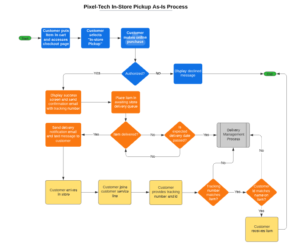
Process flows are a powerful way to visualize how work is done. They help stakeholders and developers understand the current and future state. Incorporating these into your framework can significantly improve clarity.
Process Flow Example
You can see an example of the process flow in this article.
User Story Template
User stories are a great way to document requirements for agile teams. Having clear acceptance criteria is the key to success when writing user stories. Have a good user story template in the BA framework will ensure that user stories are written in a consistent way that lead to efficiency in the team.
User Story Example
You can find examples of user story best practices in this article
You can also learn how to write user stories with a practical example in this course.
———-
User Story
As a [role], I want [capability], so that [benefit].
Acceptance Criteria
GIVEN [precondition]
WHEN [action]
THEN [expected outcome].
Edge case: [condition] → [system behavior].
Decision Log Template
Decision log templates are used to track decisions made on key items. Decisions can get hard to track as decisions makers are in multiple meetings and dealing with many different problems, having a decision log helps team has a single source of truth to refer for what has been decided.
Decision Log Example
|
Decision |
Rationale/Options |
Date |
|---|---|---|
|
Select prioritization method (MoSCoW + cost of delay) |
Balances stakeholder clarity with delivery economics |
March 21, 2026 |
|
Adopt BDD format for AC on complex flows |
Improves testability and shared understanding |
March 21, 2026 |
Change Control Template
Change control is probably on of the most useful things we can have a project as requirements always change all the time. Having a place to log the changes and get approval before making the change is essential for the success of any project
Change Control Template Example
You change control document can be in Excel and have the following sections:
- Date
- Change Description
- Status ( Open, Approved, Rejected)
- Requirements
- Team
- Decision maker/PO
- Ticket #
- Decision/Next Steps
Step 5: Documenting the Ways of Working (WoW)
Your ways of Working ( WoW) should help the team know how to work within the framework. WoW does the following:
- Remove ambiguity in day-to-day work
- Set expectations for BAs, devs, and stakeholders
- Improve speed and clarity
- Reduce rework and frustration
Think of it like team operating rules.
Examples of WoW
Sprint Ceremonies & Cadence
|
Ceremony |
Frequency |
Purpose |
|---|---|---|
|
Daily Stand-ups |
Daily, 30 min |
Quick status updates, flag blockers. |
|
Sprint Planning |
Bi-weekly |
Define work for the sprint. Starts on Wednesdays |
|
Sprint Review |
Bi-weekly |
Demo deliverables, get feedback. Happens on Tuesday the last day of the sprint. |
|
Sprint Retrospective |
Bi-weekly |
Reflect and improve how we work. Happens on Tuesdays the last day of the sprint. |
|
Backlog Refinement |
Weekly |
Prepare stories for upcoming sprints. |
|
Stakeholder Updates |
Weekly/Bi-weekly |
Share progress and align with stakeholders. |
Tools & Technology
|
Purpose |
Tool |
|---|---|
|
Project Management |
Azure DevOps / Jira |
|
Communication |
Slack / Teams |
|
Documentation |
Confluence / SharePoint |
|
Design Collaboration |
Figma / Miro |
|
Code Repository |
GitHub / GitLab |
Quality & Definition of Done
A user story or task is considered Done when:
- All acceptance criteria are met.
- Code is peer reviewed and merged.
- Unit and QA testing are complete.
- Documentation is updated.
- Product Owner has accepted the work.
Conclusion
Building a Business Analyst framework is not about creating more structure—it’s about creating the right structure. It’s about understanding how your team works, identifying what’s slowing them down, and designing a system that helps them move faster and more effectively.
If you approach it with the right mindset—focused on solving real problems rather than creating perfect processes—you’ll build something that truly makes a difference. And in doing so, you’ll position yourself as a key contributor to your organization’s success.
FAQs
1. What is a Business Analyst framework?
A Business Analyst framework is a structured approach that defines how analysts perform their work, including processes, tools, and best practices.
2. How long does it take to build a BA framework?
It depends on the complexity of the organization, but it typically takes several weeks to months.
3. What tools should be included in a BA framework?
Common tools include documentation platforms, workflow management systems, and diagramming tools. Its common to use Jira, Confluence, Word and Excel to document templates to be used in the framework
4. How do you ensure adoption of the framework?
By involving the team in the design process and keeping the framework practical and flexible.
5. What is the biggest mistake when building a BA framework?
Overcomplicating it and making it difficult for the team to use.