

Why Your First BA Project Feels Overwhelming
The Reality vs Expectations Gap
Starting your first project as a Business Analyst can feel overwhelming. You’re expected to understand systems, talk to stakeholders, and write requirements—often with little guidance.
Your first Business Analyst project often feels like being thrown into deep water without knowing how to swim. In my article How to Handle New Project Panic, I explain this and why it happens so often..
You might have studied frameworks, taken courses, or even completed certifications, but the moment you step into a real project, everything feels different.
The conversations are faster, the problems are messier, and the expectations are often unclear. You may find yourself in meetings where people speak in jargon, assume knowledge you don’t yet have, and move quickly from one topic to another. This disconnect between what you expected and what you experience is one of the biggest shocks for new analysts.
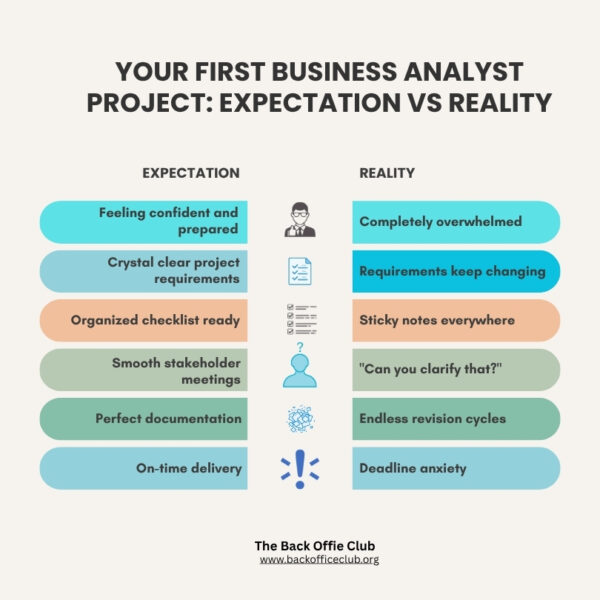
The truth is, most training focuses on structured scenarios, while real-world projects are anything but structured. Requirements are unclear, stakeholders change their minds, and priorities shift constantly. According to industry insights, Business Analyst roles are growing rapidly, with demand projected to grow over 20% in the coming years . That growth means more opportunities—but also more pressure on new analysts to perform quickly. The good news is that feeling overwhelmed is not a sign that you’re failing. It’s actually a normal part of the learning curve, and almost every experienced BA has gone through the same phase.

Why Most New BAs Feel Unprepared
The first thing you have to realize is:
- confusion is normal
- documentation is incomplete
- stakeholders assume you understand
But its ok… lets take it a step at a time.
Even the most well-prepared candidates feel unready when they start their first project. That’s because the role of a Business Analyst is not just about knowledge—it’s about applying that knowledge in unpredictable situations. You’re expected to interact with stakeholders, translate vague ideas into clear requirements, and help guide a project forward. These are skills that are difficult to fully learn in a classroom or through theory alone.
Another reason new BAs struggle is that the role sits at the intersection of business and technology. You’re expected to understand both sides, even if you come from only one background. This can create pressure, especially when developers ask technical questions or stakeholders expect business insights. The reality is that no one expects you to know everything on day one. What matters more is your ability to learn quickly, ask the right questions, and stay adaptable.
Understanding Your Role on Day One
What a Business Analyst Actually Does
At its core, a Business Analyst is a problem solver. Your job is not just to write requirements or document processes—it’s to understand problems and help teams build the right solutions. This involves gathering information, analyzing processes, communicating with stakeholders, and ensuring that everyone is aligned. It’s a role that requires both analytical thinking and strong communication skills.
You’ll likely find yourself in meetings where you need to clarify what stakeholders really want, which is often different from what they initially say. You’ll also work closely with developers, helping them understand requirements and answering questions during implementation. This dual responsibility makes the role both challenging and rewarding. It’s not about being perfect—it’s about being clear, curious, and collaborative.
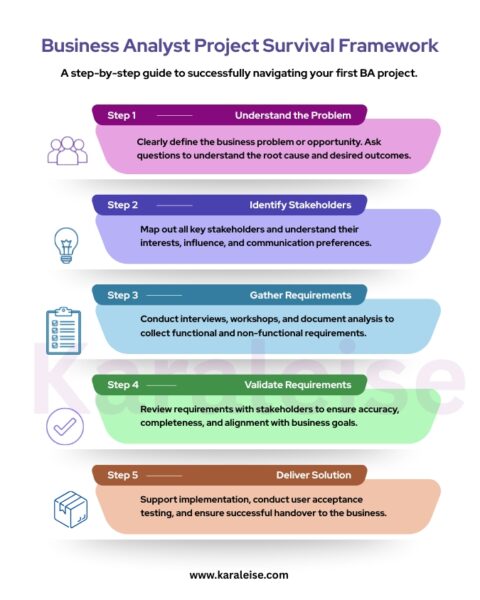
Key Skills Employers Expect
Employers look for a combination of technical and soft skills in Business Analysts. These include communication, problem-solving, stakeholder management, and an understanding of business processes. According to recent data, skills like requirements gathering, data analysis, and stakeholder communication are among the most critical for BAs . These skills are what enable you to navigate complex projects and deliver value.
What’s important to understand is that these skills are developed over time. You don’t need to master them all immediately. Instead, focus on improving one area at a time. For example, start by becoming better at asking questions or structuring information clearly. Small improvements can make a big difference in how you perform on your project.
The First 7 Days Survival Plan
What to Do Immediately
The first week of your project is critical. It sets the tone for how you’ll be perceived and how effectively you’ll work with your team. Instead of trying to impress everyone with knowledge, focus on understanding the project. Learn about the business goals, the stakeholders involved, and the current state of the process. Take notes, ask questions, and observe how the team operates.
Building relationships early is also essential. Introduce yourself to key stakeholders and team members. Understand their roles and how they contribute to the project. This will help you navigate future conversations more effectively. Remember, your job is not to have all the answers—it’s to find them.
What to Avoid Early On
One of the biggest mistakes new BAs make is trying to prove themselves too quickly. This often leads to overconfidence or making assumptions without fully understanding the problem. Avoid jumping into documentation or proposing solutions too early. Take the time to gather information and validate your understanding.
Another common mistake is staying silent in meetings. While it’s important to listen, it’s equally important to ask questions when something is unclear. Your role is to bring clarity, and that starts with speaking up. Don’t worry about asking “basic” questions—those are often the most important ones.
Common Mistakes vs Best Practices: A Square Infographic by Karaleise
How to Handle Stakeholders Without Panic
Communicating with Confidence
Stakeholders can be intimidating, especially when you’re new. They may have strong opinions, conflicting priorities, or limited time. The key to handling them effectively is clear and confident communication. This doesn’t mean you need to be perfect—it means being honest about what you know and what you don’t.
Start by listening carefully and asking clarifying questions. This shows that you’re engaged and trying to understand their needs. When you communicate, keep your language simple and structured. Avoid jargon unless necessary, and focus on clarity. Over time, this approach will build trust and credibility.
Managing Conflicting Requirements
Conflicting requirements are a common challenge in Business Analysis. Different stakeholders often have different goals, and it’s your job to navigate these differences. This requires strong facilitation and negotiation skills. Instead of taking sides, focus on understanding the underlying needs and finding common ground.
One effective approach is to bring stakeholders together and facilitate a discussion. This allows everyone to share their perspectives and work towards a solution. Your role is to guide the conversation and ensure that it remains productive. This is where your value as a BA becomes most evident.
Mastering Requirements Without Overthinking
How to Ask Better Questions
Asking the right questions is one of the most important skills for a Business Analyst. It helps you uncover hidden requirements, clarify assumptions, and understand the problem more deeply. Instead of asking generic questions, focus on specifics. For example, ask about edge cases, validation rules, and expected outcomes.
Good questions lead to better requirements, which in turn lead to better solutions. Don’t be afraid to dig deeper and challenge assumptions. This is how you add value to the project and prevent issues later on.
Writing Clear Requirements
Clear requirements are essential for successful project delivery. They act as a bridge between business needs and technical implementation. When writing requirements, focus on clarity, completeness, and simplicity. Avoid ambiguity and ensure that all necessary details are included.
Think of requirements as instructions for developers. If something is unclear, it can lead to misunderstandings and rework. By taking the time to write clear and structured requirements, you can save the team significant time and effort.
Conclusion
Your first Business Analyst project will challenge you in ways you don’t expect. It will push you out of your comfort zone and force you to learn quickly. But it will also be one of the most valuable experiences in your career. The key is to stay curious, communicate effectively, and focus on understanding the problem.
You don’t need to be perfect. You just need to be willing to learn and adapt. Over time, the things that feel difficult now will become second nature. And one day, you’ll look back and realize how much you’ve grown.
FAQs
1. What should I focus on in my first BA project?
Focus on understanding the problem, building relationships, and asking the right questions. These are the foundations of effective Business Analysis.
2. Is it normal to feel overwhelmed as a new BA?
Yes, it’s completely normal. Almost every Business Analyst experiences this in their first project.
3. How can I improve quickly as a BA?
Practice asking better questions, learn from your team, and seek feedback regularly.
4. Do I need to be technical to succeed as a BA?
Not necessarily, but having a basic understanding of technical concepts can be very helpful.
5. What is the biggest mistake new BAs make?
Starting too quickly without fully understanding the problem